


Understanding the Milestone Judgment of Carlill vs. Carbolic Smoke Ball Co. (1892)
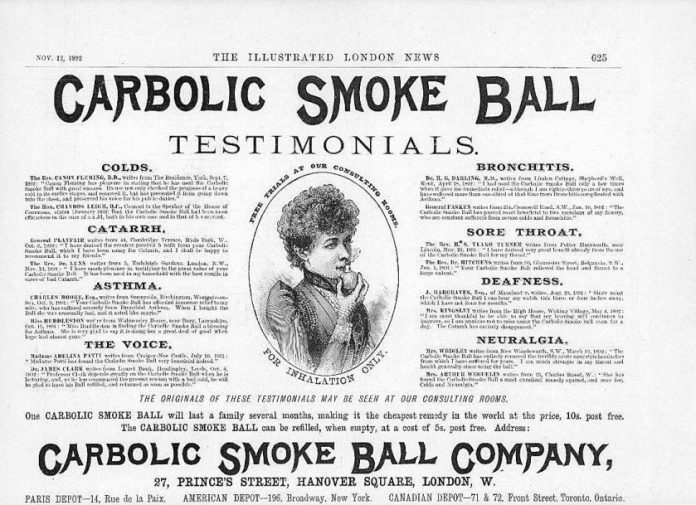
This article provides a detailed analysis of the landmark judgment of Carlill vs. Carbolic Smoke Ball Co. (1892), a case that has shaped contract law principles significantly. The case revolves around an advertisement that promised a reward to anyone who contracted influenza after using a smoke ball as per the instructions.
Introduction
The Carlill vs. Carbolic Smoke Ball Co. case established a core principle that an advertisement containing a promise conditional upon performance can constitute an offer of a unilateral contract. This case challenged preconceived notions about offers and acceptance in contract law.
Many legal luminaries, including Ms. Sankalpita Pal and Gauri Gupta, have studied and analyzed this case in detail to understand its impact on legal precedents.
Details of the Case
The case titled Carlill vs. The Carbolic Smoke Ball Company was heard on December 8th, 1892, in the Court of Appeal, UK. The claimant, Mrs. Carlill, purchased the Carbolic Smoke Ball product after seeing an advertisement promising a reward to anyone who contracted influenza after using the product as directed.
Issues Raised
- Was the contract binding on the disputing parties?
- Was formal notification of acceptance required from the claimant?
- Was acceptance of the offer sufficient to form a contract?
- Was there consideration from the claimant in exchange for the reward?
Judgement in Carlill vs. Carbolic Smoke Ball Company (1892)
The three judges, Justice Lindley, Justice Bowen, and Justice Smith, unanimously dismissed the appeal and awarded the claimant, Mrs. Carlill, a compensation of 100 pounds. They observed that the advertisement constituted a unilateral offer made to the entire world, and fulfilling the conditions of the offer was sufficient to accept the offer.
Significance of the Judgement
The Carlill vs. Carbolic Smoke Ball Co. judgment established fundamental principles in contract law, especially regarding offers, acceptance, and consideration in unilateral contracts. It set a precedent for future cases involving similar situations and highlighted the importance of honoring commitments made through advertisements.
Frequently Asked Questions (FAQs)
What is a general offer?
A general offer is an offer made to the public at large that can be accepted by anyone who fulfills the specified terms and conditions set forth in the offer.
How is an offer different from an invitation to treat?
An offer is a clear proposal to enter into a legally binding contract, while an invitation to treat is an expression of willingness to negotiate but not a binding offer.
What are the similarities between a unilateral contract and a bilateral contract?
Both unilateral and bilateral contracts bind the parties legally and require a promise and consideration to form a valid contract.
What was the significance of the 1000 pounds deposited in the Alliance Bank?
The deposition of 1000 pounds showed the company’s sincerity and intention to enter into a legally binding contract with consumers who fulfilled the offer’s terms.
Will the case serve as a precedent in the case of online advertisements?
Yes, the principles established in this case will be applicable to online advertisements as well, ensuring clarity in offers and acceptance.
How does the judgment influence contract law in contemporary times?
The judgment of Carlill vs. Carbolic Smoke Ball Co. continues to have a significant impact on contract law principles, especially in cases involving unilateral contracts and consumer protection.
Conclusion
In conclusion, the Carlill vs. Carbolic Smoke Ball Co. case remains a cornerstone in contract law, establishing key principles of unilateral contracts and consideration. It serves as a guiding light for legal practitioners and students, shaping the foundation of legal education and practice.


